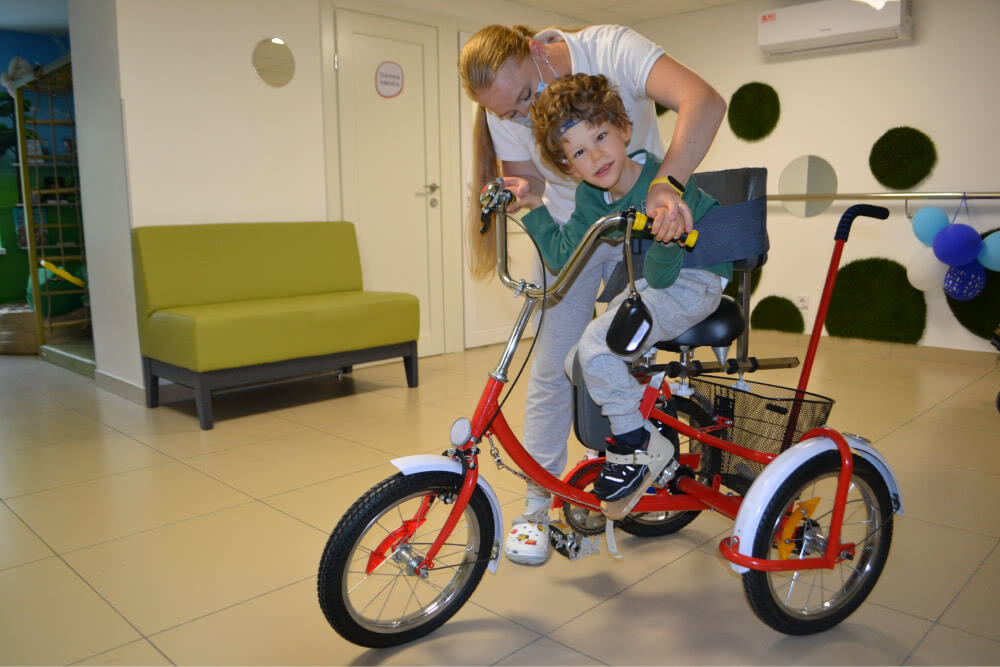
Assistive devices (AS) are not just a wide range of equipment for children, they are their independence and new possibilities. Depending on the functional status, we select different equipment to increase the mobility of the child.
The list of mobility aids:
- Active wheelchairs;
- Electric wheelchairs and smart wheelchairs;
- Sticks (one-point, three-point and four-point);
- Crutches;
- Walkers;
- Active vertical wheelchairs;
- Rollators;
- Bicycles.
Let’s look at assistive devices for Level V-II GMFCS (Grand Motor Functions Scale) children.
Level V children move around only with adult supervision or assistance. If their motor skills allow, a power wheelchair can be used to move around. For high level V, we use the r82 Mustang walker with a full set of supports.
Level IV children often travel long distances in a wheelchair assisted by parents, rarely in an active wheelchair or with an electric drive. They can walk short distances with the help of a walker. Active wheelchairs are also used for moving around the apartment.
Level III children walk for long distances with walkers or rollators, and for short distances with sticks.
It is very important to choose the right type and size of aids. It is not always possible for the child to move independently when trying it on for the first time; you must give it some time to get used to it.
If you notice that the child gets tired while using the aids, you should think about replacing the aid with an easier one. For example, if a child walks short distances with sticks, but gets tired for long distances, in this case it is better to choose a walker.
A myth for many parents is that if a child is given an aid, he will not walk on his own. This is not true! For a child at a high level who is physically ready to walk, the walker can be a great stimulus for independent movement, the assistive device will give them freedom of movement.
Customizing the mobility aid is an important component in the life of a child with a disability.
With BC, contractures and deformities can be prevented and spasticity and hyperkinesias can be reduced.
The physical therapists at the John’s Center are always available to consult with parents and help their children choose the appropriate assistive device.
The article was prepared by Anna Mikhailova, assistant physical therapist at the St. John’s Center.