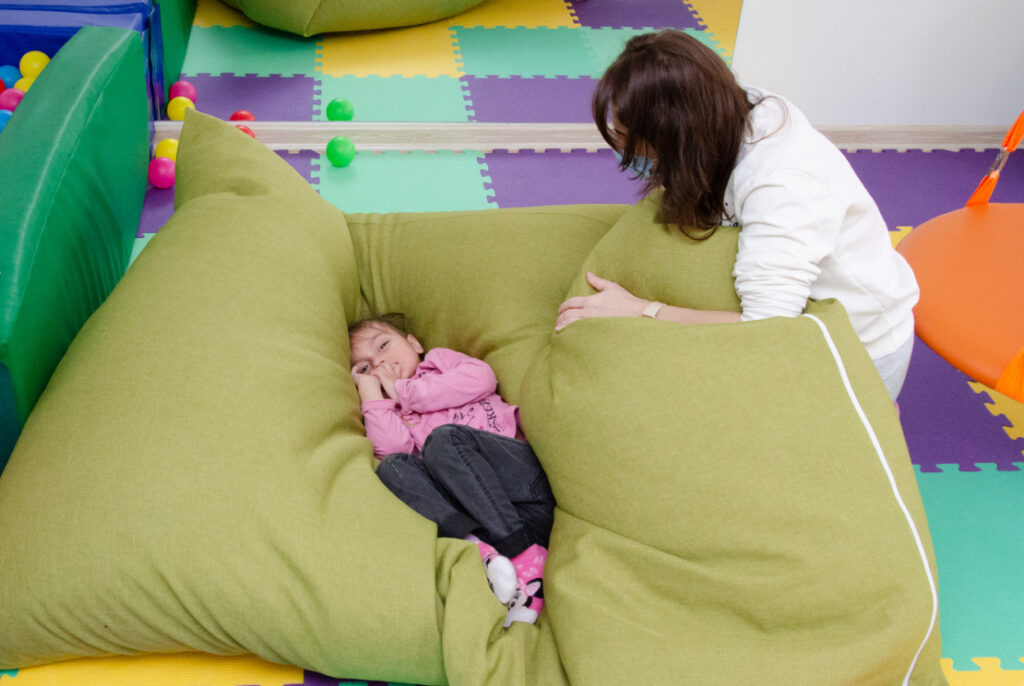
If your child has a headache, tummy ache or armache, if he or she has speech, he or she will tell you about it quickly. But there are neurological disorders that are very difficult for parents to notice, and children themselves are not always able to report them and understand the cause of their discomfort. There can be many of these disorders, but today we will talk about a sensory disturbance.
About 40 years ago, Jean Ayres, a speech therapist and psychologist from Oklahoma (USA), in the course of her practical work, came up with the theory of sensory system dysfunction – the theory of sensory integration dysfunction. This theory in the modern correctional and habilitation direction has gained popularity and is used in most institutions working with children who have neurological disorders and certain psychiatric disorders, and has proven to be an effective technique that children are happy to accept.
Sensory integration therapy has proven to be excellent in working with children who have an autism spectrum disorder. Although the method itself has not yet been scientifically and empirically validated, and children who receive corrective and developmental sessions with a speech therapist, psychologist, and sensory therapist in combination show better results than those children who work with only one of these specialists.
About Autism.
Autism spectrum disorder is just one of the psychiatric developmental disorders whose symptomatology is characterized by features of cognitive and emotional development and atypical behavior.
It is manifested in:
- understanding and expression of speech;
- The development of an attachment and value system;
- social adaptation;
- Absence of story play or play with certain features.
Autism can be accompanied by mental retardation, concentration problems, decreased motivation to learn and communicate. Recent research partially confirms that autism is on the one hand impaired cognitive processing of social information and on the other hand impaired processing of sensory information and delayed development of large and fine motor skills.
Only the manifestation of stereotyped behavior refers to impaired sensorimotor development. For example, stereotypic movements or actions can be a manifestation of emotional overload or inability of the nervous system to adapt to changes in the environment (light, sounds, smells) or as an escape from social interaction.
Therefore, a delay in sensorimotor development of the autistic child, on the one hand, can be explained by the fact that children who have not passed the stage of group play are in a state of social deficit. For example, the manifestation of autoaggression can be explained by the child’s inability to cope with emotions, or the inability of the nervous system to quickly give an adaptive response to a stimulus.
Methods of correcting autism
Since autism is a complex and multifaceted child development disorder, there are a large number of corrective techniques in the world, namely:
- Behavioral Approach;
- Corrective and developmental approaches;
- Sensory-integrative therapy;
- Eclectic approaches.
Sensory-integrative therapy is a form and organization of education and development of a child that has a certain format and schedule of activities and is aimed at stimulating the necessary organs and sensory systems. A perfect diagnosis of the sensory profile is made at the beginning of the class and a schedule and form of sessions is arranged.
How Sensory Integration Therapy Works
The workings of the central nervous system are a complex neurological process. Touch helps us to see and feel, vision helps us to keep our balance, balance in turn helps us to feel our body position in space and move. Movement helps us learn and experience the world. The brain needs stimulation; it excites the appropriate parts of the brain and creates functional activity in it. This is how we can breathe, eat, walk and learn.
Constant and active stimulation allows the formation of new neural connections, i.e. new abilities and skills. The flow of nerve impulses from the sensory organs conditions the development of the nervous system. If there are disorders at birth, the process of sensory differentiation will have corresponding dysfunctions. How a child perceives the world around him or her directly affects development, emotions, and thoughts.
Children with autism often cannot identify sensations from internal organs, cannot control breathing, and do not experience hunger; the interoception is responsible for this.
Children with tactile dysfunction may often have difficulty eating without touching certain textures and objects. They have difficulty acquiring certain articulatory skills, which affects speech development.
Proprioceptive function is responsible for the positioning of the body in space, which in turn is both coordination and the development of fine and large motor skills. Impairment of the perception of sensations from the organs of hearing, taste and smell can lead to destabilization not only of the emotional state but also of the physical one. Therefore all activities are based on diagnostics and study of the child’s features by conversations with parents, observation and only then are activities planned.
About Game
An important point in remedial work with children with autism is the development of play. Sensory-integrative therapy provides opportunities for situational play, interaction and communication.
The main task of the therapist is to correctly direct the impulse of the child’s initiative and help develop, in simple actions, a story game similar to the real one, in which emotions and rules of interaction can be reproduced.
Watching a therapist working with your child, it will seem like just a game. But be assured that this game is clearly planned and thought out. Filled with content, controlled and adapted to your child.
The article was prepared by Tatiana Belokha, psychologist at the John Center.