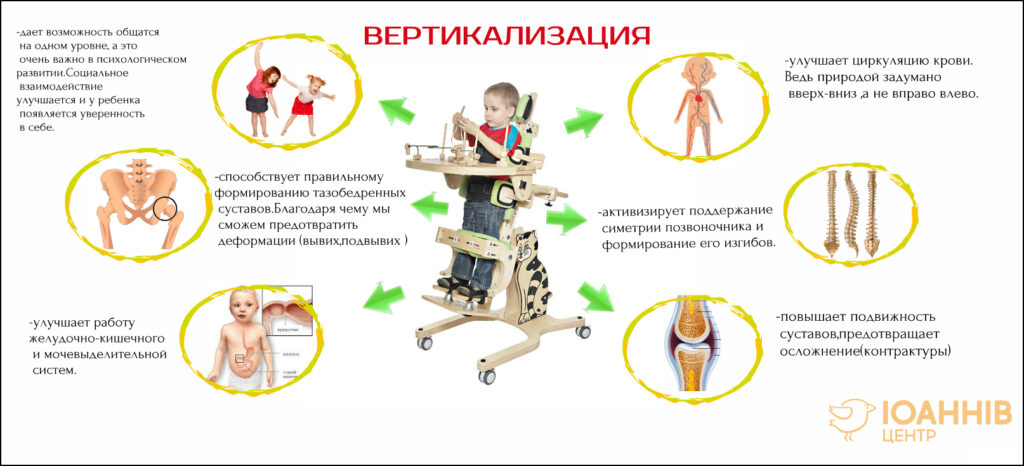
Many parents believe that bed-ridden children do not need to be upright, and are very surprised when they hear the opposite. Unfortunately, the idea of such a device as an upright, very distorted, parents either have not heard about it at all, or received a negative response from specialists. In this article we will tell you about the pros and cons of standing and help you to understand the topic.
Verticalization is a special device that helps a lying person to get into an upright position. It is also used in the rehabilitation of children with cerebral palsy, disorders of the musculoskeletal system. The effectiveness of the verticalizer is very high, besides, it can be used at home.
Why is verticalization necessary?
Our body is built on the vertical principle, and therefore most of the day we spend in a standing position. In this state, the proper activity of absolutely all systems of the body is performed.
According to evidence-based medicine, verticalization is an important point in rehabilitation. This method helps to improve blood circulation, increases joint mobility, improves the function of the gastrointestinal system and promotes the correct formation of the hip joints. The recovery process is much faster, and the threat of secondary complications is reduced.
With regular verticalization the child’s psychological state improves, because there is an opportunity to communicate “at the same level. The upright position activates interaction and, therefore, awakens determination and self-confidence.
At what age should a child be upright?
According to the developmental norm, children make their first independent attempts to stand up at the age of 9-10 months. In order to hold an upright position, they use a support.
We believe that the verticalization of children with motor disorders should begin at the same age or a little later (up to 12-14 months). All this is individual and is determined by specialists.
The advantages of verticalization:
- prevention of contractures;
- correct formation of the hip and knee joints;
- Improvement of the functionality of the upper extremities;
- axial load on the spine;
- improvement of leg muscle strength;
- prevention of cognitive disorders.
- Minuses of verticalization:
There may be negative effects only if:
- the verticalizer is not suitable in terms of parameters;
- the individual characteristics of the body are not taken into account;
- Improper positioning.
So, we have seen the usefulness of the verticalizer, that its use brings positive dynamics in the rehabilitation of children with neurological diseases. But this equipment must be properly selected with a specialist, according to the individual characteristics of the child.
The physical therapists at St. John’s Rehabilitation Center are always ready to advise you on the choice of the vertical leveller and other devices.
This article was prepared by Anna Mikhailova, assistant physical therapist at the St. John’s Center